The post Should you outsource your digital marketing? appeared first on Yellow Pages.
]]>As beneficial as digital marketing is, however, it requires significant expertise, resources and time. This is where outsourcing your digital marketing tasks can be a game-changer for small to medium-sized businesses.
Outsourcing allows you to focus on what you do best—serving your customers and refining your products or services—while experts handle your digital presence. Whether you’re looking to drive more traffic, increase sales or build brand awareness, outsourcing digital marketing can bring you closer to your goals with less strain on your internal resources.
This approach is not only practical but also aligns perfectly with the needs of businesses looking to scale efficiently and effectively in today’s competitive marketplace. Let’s explore how outsourcing digital marketing can bring about transformative benefits for your business.
The benefits of outsourcing digital marketing.
Outsourcing your digital marketing is a strategic approach that can yield substantial benefits for businesses, especially those looking to grow and innovate while managing costs effectively. Here are some key advantages to consider:
Cost efficiency.
One of the most compelling reasons to outsource digital marketing is cost efficiency. By partnering with external experts, businesses can avoid the significant expenses associated with hiring full-time professionals, which include salaries, benefits and ongoing training costs.
Outsourcing allows you to pay only for the services you need when you need them, without the overhead of a full-time staff. This model can lead to considerable savings while still achieving high-quality marketing outcomes.
Access to expertise.
Digital marketing is a field that is constantly evolving, with new tools, techniques and platforms emerging all the time. Outsourcing gives you access to professionals who specialise in these areas and are up-to-date with the latest trends and technologies.
Whether you need expertise in SEO, social media, content marketing or paid advertising, you can have top-tier talent working for you, ensuring that your digital marketing efforts are state-of-the-art and strategically sound. This, of course, includes the expertise to analyse the results of your marketing and scale your efforts accordingly.
Scalability.
Outsourcing digital marketing offers flexibility that is hard to achieve with an in-house team. As your business needs change, you can easily scale your marketing efforts up or down without the logistical challenges of hiring or downsizing. This flexibility ensures that your marketing strategy can adapt quickly to market changes, seasonal demands or new business opportunities, providing a perfect fit for your evolving needs.
Focus on core business.
By outsourcing your digital marketing, your internal team can focus on what they do best—developing your core business. This can mean more time and energy spent on improving products and services, enhancing customer service and pursuing new business opportunities.
Outsourcing allows your team to concentrate on driving the business forward while leaving the complex, time-consuming tasks of digital marketing to trusted professionals.
The drawbacks of outsourcing digital marketing.
While outsourcing digital marketing offers numerous benefits, there are also challenges to consider. One primary concern is the loss of control over certain aspects of your marketing strategies.
When tasks are handed over to external agencies, businesses might feel detached from the day-to-day management and execution of these tasks, potentially leading to a misalignment with the overall business vision.
Misaligned brand awareness.
One of the reasons that businesses utilise digital marketing, whether outsourced or not, is to build their brand awareness. So it is almost ironic that one of the downsides to outsourcing your digital marketing to an external agency is the risk that they might not be aligned with your brand or business.
Finding the right agency that truly understands your brand’s voice and ethos can be challenging. There’s always a risk of inconsistency in how your brand is represented online if the agency doesn’t fully grasp your brand identity or fails to communicate effectively with your internal team.
One of the best ways to ensure this doesn’t happen is to provide the agency with a comprehensive brief regarding your core business vision and ethos, your products and/or services, your customer personas and your style guidelines, such as your branding, tone of voice, etc.
Integrating processes can be challenging.
Another potential downside is the dependency on external parties for critical business functions, which can lead to vulnerabilities, especially if the outsourcing partner faces disruptions.
Also, the integration of external teams with internal processes might introduce complexities and inefficiencies, particularly if there are significant differences in work culture or operational approaches.
While outsourcing can be highly beneficial, these factors must be carefully considered and managed to ensure that outsourcing decisions bolster rather than hinder your marketing objectives.
What to do before outsourcing your digital marketing.
Before diving into outsourcing your digital marketing, it’s crucial that you clearly define your marketing needs and how these align with your overarching business objectives. This initial step ensures that your outsourcing efforts are both strategic and effective.
Assess your business goals.
Start by revisiting your business goals. Are you looking to increase brand awareness, boost sales or reach new customers? Perhaps you’re aiming to improve customer engagement or optimise your customer service. Whatever your goals, understanding them is the first step in tailoring your digital marketing strategy.
Once these goals are clear, you can determine how digital marketing can help achieve them. For instance, if increasing sales is the goal, strategies like Pay-Per-Click (PPC) advertising and SEO can drive targeted traffic to your website, enhancing the likelihood of conversions.
Identify key areas for outsourcing.
Once you have a clear understanding of your business goals, you can identify which aspects of your digital marketing to outsource. Consider the following areas:
- Social media management: Outsourcing this can help you maintain a consistent presence on social platforms where your audience spends their time, engaging them with high-quality content and interactions.
- Content creation: High-quality engaging content is pivotal for SEO and customer engagement. Outsourcing content creation can ensure that your blogs, videos and infographics are both professional and strategically crafted to meet your objectives.
- Search engine optimisation (SEO): SEO experts can enhance your website’s visibility and organic search rankings, driving more traffic and potential customers to your site.
- Email marketing: This is another area where outsourcing can help you design, write and manage effective email campaigns that convert subscribers into customers and customers into loyal brand advocates.
By carefully selecting which aspects to outsource, you can leverage specialised expertise to maximise the effectiveness of each element of your digital marketing strategy, ensuring they are aligned with your business objectives.
To do this, reach out to marketing companies that offer free advice as part of the initial consultation, asking them to propose a digital marketing strategy tailored to your business. You can then choose the strategy that best fits your needs and your budget.
Choosing the right digital marketing agency.
Selecting the right digital marketing agency is pivotal to the success of your outsourcing efforts. A good agency will act as an extension of your team, bringing expertise and innovation to your marketing strategies.
Here at Yellow Pages we have experience across a range of digital marketing channels and a strong track record at delivering results for our customers. We offer complete transparency across our processes and communications with your business, ensuring we deliver the results that matter to you most.
Learn more about our digital marketing products or get in touch with an expert at Yellow Pages today.
The post Should you outsource your digital marketing? appeared first on Yellow Pages.
]]>The post Marketing Jargon Buster: Long-tail keywords appeared first on Yellow Pages.
]]>Long-tail keywords are more specific keyword search phrases that people tend to use when they are close to the point of purchasing a product or service, or when they are using voice search. Long-tail keywords are also used a lot in local searches, highlighting the need for your business to have good local SEO.
Examples of long-tail keywords:
- ’24 hour blocked drain plumber in Geelong’
- ’emergency drain plumber near me’
- ‘drain blockage specialist Geelong West’
- ‘experienced drain plumber near me’, etc.
A group of long-tail keywords are often used to create cost-effective SEM campaigns. Rather than competing for the word ‘plumber’, which is always going to be more expensive, your business can focus on cheaper long-tail keyword options, such as ‘drain blockage specialist Geelong West’.
RELATED: SEO vs SEM: What’s the difference and do you need both?
Similarly, factoring long-tail keywords into your SEO means that you will be targeting customers who are actively shopping for what you provide, and what areas you provide it to.
RELATED: eBook: The SMB’s guide to local SEO.
The post Marketing Jargon Buster: Long-tail keywords appeared first on Yellow Pages.
]]>The post Digital marketing strategy must-haves for regional businesses: a practical guide. appeared first on Yellow Pages.
]]>This guide outlines the essential digital and online marketing strategy must-haves for regional small business owners, providing actionable steps to build a comprehensive marketing plan that drives growth, nurtures leads and builds loyal customers.
1. Build hands-on digital marketing skills.
-
Self-learning & courses:
Enhance your expertise in SEO, social media platforms, CRM, email marketing and content marketing using free tools and online courses. You don’t need to return to uni—there’s plenty of helpful information available tailored to small business owners.
-
Apply your knowledge:
Test new techniques, from Google ads to pay-per-click (PPC) campaigns, on low-risk projects. Use tools like Google Analytics and keyword research to identify opportunities and track your marketing efforts.
-
Set clear goals:
Define measurable objectives using SMART goals, KPIs or ROI targets. A clear marketing plan will ensure that every campaign—from a Facebook campaign to targeted messages—has direction and drives paying customers.
-
Identify your buyer persona:
Understanding your business and audience is crucial. As a small business owner, effectively utilising digital marketing strategies can significantly enhance your online presence. Tailor your approach to niche targeting and email campaigns to engage your specific audience.
2. Develop a strong email marketing strategy.
-
Stay connected over distance:
For regional businesses covering wide areas, email marketing is a powerful way to nurture leads and stay in touch with both existing customers and potential interested customers.
-
Mix your emails:
Combine relational emails (to build trust and improve customer interactions) with promotional emails that share relevant content and highlight your latest services. This balanced approach helps attract new customers and maintain a loyal customer base.
-
Automation & segmentation:
Leverage email marketing platforms to segment your audience and automate your campaigns. This ensures personalised communication that resonates with your target audience and reinforces your brand identity.
RELATED: 8 examples of brilliant email marketing campaigns.
Master local search engine optimisation for your digital marketing strategy.
-
Optimise your listings:
Ensure your business appears in local search results by optimizing your website, google business profile, and local directories with location-specific keywords. This is crucial for increasing visibility and attracting new customers via search engine optimisation.
-
Create local content:
Develop content that speaks directly to your community. For instance, a florist in Tamworth might write a post on ‘the best flowers in season in Tamworth’. Incorporate buyer personas and market research to craft posts that address your audience’s pain points and interests.
-
Leverage research tools:
Utilise free tools like Ubersuggest and keyword research platforms to discover what your target audience is searching for, then tailor your content to match these digital marketing strategies.
RELATED: Your simple SEO checklist: Optimising your content.
4. Ensure mobile-friendly design.
-
Responsive design:
With many regional customers using mobile apps and social media channels to access content, test your website on various mobile devices. A fast-loading, responsive site is a good marketing idea that improves user experience and search engine rankings. Additionally, leveraging social media apps like Facebook, Instagram and TikTok for video marketing can effectively engage consumers and make DIY video marketing accessible and budget-friendly.
-
Optimise visuals:
Compress images and streamline code to improve loading times. This is essential in areas with slower internet speeds and helps ensure that your site looks great on both social media accounts and landing pages.
-
Improve user experience:
Simplify navigation with clear menus and a touch-friendly interface. This reinforces the overall user experience and helps you stand out from your direct competitor by providing a better service.
RELATED: 6 UX website best practices every business owner should use.
5. Leverage flexible staffing options.
-
Freelancers and contractors:
For specialised tasks—such as content writing, SEM or managing social media posts—engage remote marketing freelancers. This allows your business to tap into expert services without the overhead of a full in-house team.
-
Interns:
Consider partnering with local universities or trade shows to recruit digital-savvy interns. They can offer fresh perspectives and help manage social media, market research or even content creation on a budget.
-
Scale as needed:
Flexible staffing lets you adjust your marketing activities in real time, ensuring you have the right mix of assets to drive qualified leads and increase sales.
6. Collaborate with a digital marketing partner.
-
Full-service support:
If your marketing strategy requires a more comprehensive approach, consider partnering with a digital marketing agency.
-
Integrated approach:
An agency can help you integrate your marketing efforts across various platforms, ensuring that your online marketing strategy is cohesive and aligned with your overall business goals. This synergy is a powerful tool for driving new customers and referred customers alike.
-
Cost efficiency:
Benefit from the agency’s economies of scale and specialised expertise, which can be a free way to leverage powerful tools and strategies without breaking the bank.
7. Implement a comprehensive strategy and monitor performance.
-
Develop an overarching plan:
Create a small business marketing strategy that integrates all channels—email, local SEO, mobile optimisation, social media and paid ads. This comprehensive approach ensures that every effort is aligned and working towards the right audience.
-
Track key metrics:
Use Google Analytics and other performance tools to monitor traffic, conversion rates, and customer interactions. Analyse your data to see which social media platforms or online marketing strategies are most effective in driving quality traffic.
-
Iterate and improve:
Regularly review your performance and adjust your tactics. Continuously optimise your content, update your landing pages and refine your marketing activities to nurture leads and turn them into happy, paying customers.
RELATED: Content marketing strategy [TEMPLATE].
Avoid common digital marketing pitfalls.
Even the best strategies can falter if you fall into common traps. Here are mistakes to avoid:
-
Unclear goals:
Without measurable objectives, your marketing efforts lack direction.
-
Neglecting paid channels:
Don’t ignore SEM, PPC and Google ads opportunities—they amplify your reach when combined with organic efforts.
-
Overlooking quality SEO & content:
Relying solely on paid advertising without investing in quality content and search engine optimisation limits long-term growth.
-
Ignoring social platforms:
A strong presence on social media and local directories is essential for engaging potential customers.
-
Fragmented strategy:
Ensure that all your digital marketing efforts—from content marketing and email campaigns to social media posts—are aligned with your overall marketing plan.
Key takeaways.
- Skill building: Invest in digital marketing education and set clear, measurable goals to drive your efforts
- Email marketing: Use a mix of relational and promotional emails to nurture leads and build loyal customers
- Local SEO: Optimise your online presence for local searches to capture ‘near me’ traffic and potential customers
- Mobile optimisation: Ensure your site is fast, responsive and user-friendly on mobile devices
- Flexible staffing: Leverage freelancers, contractors and interns to scale your marketing activities efficiently
- Digital partnerships: Collaborate with a full-service agency for an integrated approach that enhances your overall marketing strategy
- Comprehensive strategy: Continuously monitor and refine your tactics using powerful tools like Google Analytics to stay competitive and drive new customers
- Avoid pitfalls: Stay aware of common mistakes to maintain a cohesive, effective marketing plan.
By implementing these must-haves and avoiding common mistakes, regional businesses can build a robust small business marketing strategy that drives growth, builds local trust and delivers measurable results. Use this guide as your roadmap to elevate your online presence, reach the right audience and turn potential leads into loyal customers.
If you need help with your digital marketing plan, Yellow Pages has you covered. We offer a suite of products and services to take your digital marketing to the next level, from search engine marketing to social ads, to a listing on Yellow Pages Online. Get in touch with us today to find out how we can help you grow your business.
The post Digital marketing strategy must-haves for regional businesses: a practical guide. appeared first on Yellow Pages.
]]>The post Marketing Jargon Buster: UX Designer. appeared first on Yellow Pages.
]]>A user experience (UX) designer focuses on creating products that provide meaningful, accessible and relevant experiences to users. While physical products also have user experiences – trying on a pair of shoes, for example – the term is most often associated with digital products like websites and apps.
UX designers prioritise the user’s overall experience with a digital product or service, from their initial interaction – such as clicking on a Google Ad leading to a landing page – to completion of a task. What the complete task looks like depends on your industry and your business’ goals, however completion usually refers to generating a lead or a conversion.
RELATED: How to make Google Ads work for your small business.
The post Marketing Jargon Buster: UX Designer. appeared first on Yellow Pages.
]]>The post Marketing Jargon Buster: Presence management appeared first on Yellow Pages.
]]>‘Presence management’ is the process of presenting your business and brand online, and drawing traffic to your website, through managing your online presence.
This includes:
- Online reviews
- Web design and development
- Blogging
- Search engine optimisation (SEO)
- Pay-per-click (PPC) marketing
- Reputation management
- Directory listings
- Social media
- Link sharing
Ensuring that all these elements of your online presence are a consistent and an accurate representation of your brand improves your performance in search engine results pages (SERPs), helping to grow your business.
RELATED: Why local SEO is worth the time and investment.
https://youtube.com/watch?v=o5aNKKW9Wdg%3Fsi%3Dv3fMMtUQjFaTFuLy
RELATED: Google AI Overview: Optimising for search in Australia in 2025.
The post Marketing Jargon Buster: Presence management appeared first on Yellow Pages.
]]>The post Google AI Overview: Optimising for search in Australia in 2025. appeared first on Yellow Pages.
]]>We covered Google’s Search Generative Experience (now known as AI overview) last year when it started to roll out across the US, discussing the potential impact it will have on search in Australia (read the article here). Now that it is officially being rolled out within Australian search engine results pages (SERPs) we thought we’d take a closer look and help to define exactly how this will impact our approach to content marketing and SEO in 2025.
What is a Google AI Overview?
The Google AI Overview is a search feature powered by generative AI that provides summarised and context-rich answers to user queries directly on the search results page. Instead of scrolling through multiple links, users now receive comprehensive overviews synthesised from high-quality sources. This innovation aims to make information more accessible, precise and actionable.
Google’s search has been transformed by the Search Generative Experience (SGE), which integrates advanced AI to deliver these comprehensive, AI-generated summaries. As a recently new feature, there are frequent changes. A part of these changes can include the same search result not triggering an AI Overview each time. With AI overviews continually evolving, it can be noted that on average it has only appeared for 10% of search queries.
What does Google AI Overview look like?
Google AI Overview appears at the top of the search results page as a visually distinct and interactive module. They are typically positioned above the traditional organic search results.
The AI Overview is usually laid out with a concise summary of synthesised information from varying trusted sources. They will include clickable links in the overview or link cards below the summary.
See below for a few examples of what Google AI Overview search results look like.
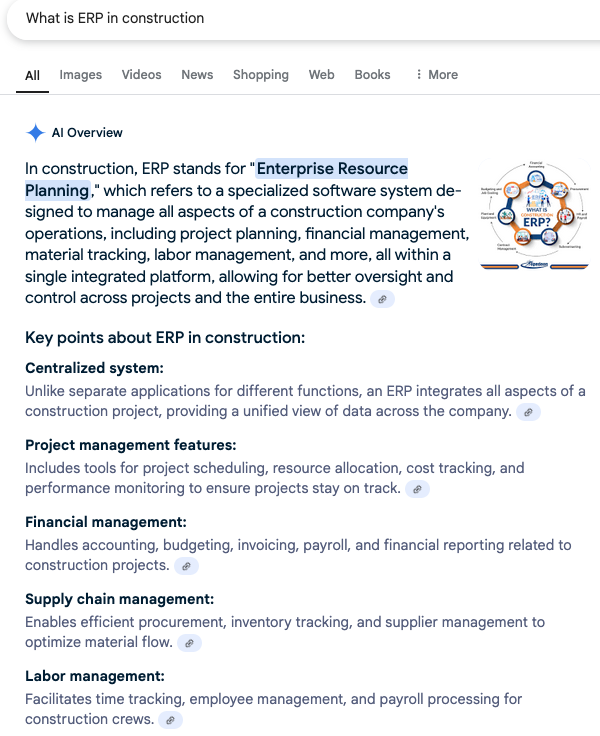
1. ‘What is ERP in construction’ -> The below AI Overview result pulled data from multiple sources to answer the query of what ERP stands for within the first sentence and then briefly notes the advantages of ERP and how it relates to construction.
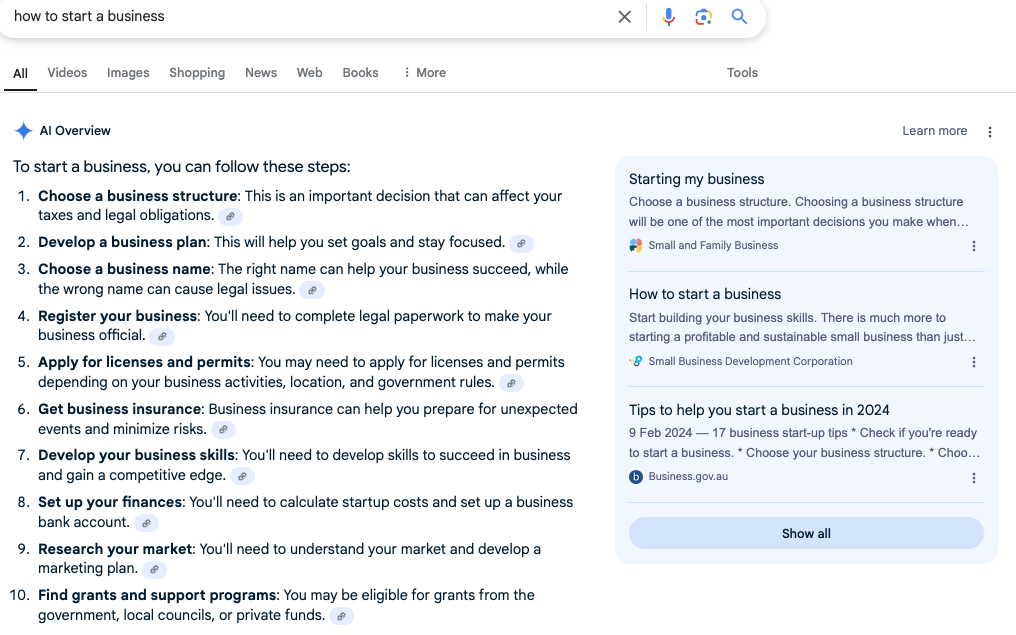
2. ‘How to start a business’ -> The AI Overview result has summarised the process of starting a business in concise dot points, with credible pages linked to the right of each step. In one clear view this serves the informational search intent of the user.
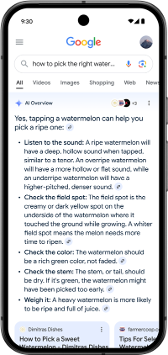
3. ‘How to pick the right watermelon’ -> The AI Overview result clearly and concisely answers the users query in the opening sentence. Following this in dot points, it then highlights key relevant information on steps to achieve the outcome of the query.
Is AI overview available in Australia?
Yes, Australian users can now access AI Overview as part of Google’s global rollout. Google has tailored the feature to accommodate regional nuances, ensuring relevance to Australian businesses and consumers.
How is the AI Overview affecting SEO?
AI is revolutionising SEO by shifting the focus from keyword-stuffed strategies to focusing on user intent and high-quality content. Algorithms are now better at understanding context and delivering the most relevant results, emphasising the importance of delivering real value through content. Understanding the customer journey is crucial in this context, as it allows businesses to map out the steps consumers take from awareness to purchase.
With the rise of AI search, zero-click searches have also increased. An SEMrush study in 2022 notes that zero-click mobile search share was at 57%. This highlights how search behaviour and engagement has changed, as users can now find the answers in position zero of the search pages and therefore don’t need to proceed through to the website.
RELATED: What is ‘Keyword stuffing’?
How do I optimise my website to appear in Google AI Overviews?
With AI Overview prioritising high-quality and authoritative content, SEO strategies must evolve. To increase the chances of appearing in AI Overviews:
1. Build and maintain a strong foundation of SEO and brand.
Google’s AI Overview prioritises authoritative and credible sources. Building a strong SEO foundation and brand reputation is key to gaining visibility.
- Focus on expertise and relevance: Develop content that directly addresses user queries with authoritative insights. Conduct keyword research that prioritises user intent over keyword density.
- Adhere to Google’s Search Quality Rater Guidelines: These guidelines provide insights into what Google considers high-quality content, focusing on expertise, authoritativeness and trustworthiness (E-A-T). By aligning your content creation process with these standards, you increase the likelihood of being recognised as a reliable source by Google’s algorithms and AI.
- Build a foundation of good Technical SEO practices: A technically sound website is crucial for appearing in AI Overviews. Focus on these key elements:
- Leverage structured data: Use schema.org markup to make your content more accessible to Google’s AI. Structured data helps identify key points, such as FAQs, product details and reviews, which are often featured in AI Overviews.
- Streamline navigation: Ensure users can access any page on your site within three clicks.
- Secure your site: Use HTTPS for trust and data protection.
- Improve load times: Compress images, minimize JavaScript, and use browser caching for fast performance.
- Fix errors: Use tools like Google Search Console to resolve crawl issues and broken links.
- Stay mobile-friendly: With mobile searches dominating, ensure your website loads quickly, has a responsive design and provides a seamless user experience.
RELATED: On-page SEO vs technical SEO: what is the difference?
2. Optimise content with concise summaries.
Google AI Overview thrives on delivering concise yet comprehensive answers. Tailor your content to align with this format.
- Write clear introductions: Start each website page, blog or article with a succinct summary of the topic. Think of it as a preview of what the reader will gain by engaging further.
- Highlight key information: Use headings, bullet points and infographics to make your content easily digestible. AI Overviews often pull data from well-structured and scannable content.
- Answer FAQs directly: Include an FAQ section that answers common questions about your topic. Use straightforward language and link to more detailed content for readers who want to dive deeper.
3. Align content with evolving search behaviour.
Google’s AI Overview responds to user intent and conversational queries. Adapting your content strategy to this trend is essential.
- Create conversational content: Write in a tone and style that mimics how users search online. For instance, instead of creating content titled ‘Car Maintenance Tips’ try ‘How Do I Maintain My Car in Winter?’
- Incorporate multimedia: Include high-quality images, videos and charts that enrich the content. AI Overview often pulls visuals to complement the text summary, which can improve engagement.
- Refresh old content: Update existing content to reflect current trends, user queries and search behaviour. Keeping content relevant ensures it remains eligible for inclusion in AI Overview.
4. Emphasise quality over quantity.
Gone are the days of publishing excessive amounts of low-quality content. Google’s AI Overview values depth and quality.
- Invest in long-form content: Create comprehensive guides and in-depth articles that thoroughly explore a topic. Longer content, when well-structured, has a higher likelihood of being summarised by AI Overview.
- Cite credible sources: Link to reputable and authoritative websites. This not only boosts your content’s credibility but also increases trust in the eyes of Google’s algorithms.
- Use data-driven insights: Support your content with statistics, case studies and real-world examples. AI Overview tends to highlight content that offers practical, actionable insights.
By combining these strategies, businesses can effectively position themselves to feature prominently in Google’s AI Overview, gaining greater visibility and driving more meaningful engagement with their audience.
RELATED: Your SEO content checklist: where and how to optimise your content.
Aligning AI Overviews with search intent.
AI Overview’s ability to understand and match search intent is its core strength. For businesses, this means focusing on creating content that mirrors what users are genuinely looking for. Identifying and addressing the ‘why’ behind a search query can significantly improve a site’s visibility.
For example, if users search for ‘best cafés in Melbourne’, providing a detailed listicle with ratings, photos and updated information about each café increases the likelihood of appearing in an AI Overview.
The benefits of AI Overview for users.
AI Overview offers several benefits for users, including more accurate and relevant results, detailed answers to complex questions and a more personalised search experience. Unlike traditional search engines, AI search engines can provide users with comprehensive answers that include important information about a business, such as its services and expertise. This makes AI search a valuable tool for quick questions and in-depth research alike.
How does Google AI Overview positively affect small business growth?
Small businesses stand to gain significantly from AI Overview. By providing clear and direct answers, the feature helps level the playing field, giving well-crafted, localised content a chance to shine alongside larger competitors. Local SEO strategies—like maintaining a robust Google Business Profile and generating customer reviews—are more critical than ever. Optimising local business listings can significantly enhance visibility and credibility for businesses.
RELATED: How to set up and update your Google Business Profile.
AI related tips to make informed decisions for SEO.
To succeed in an AI-driven SEO environment, businesses should:
- Use AI tools for keyword research and content creation.
- Optimise for voice search, as conversational queries are on the rise. Covering the topic in-depth with conversational search patterns of long-tail search terms will assist in increasing relevance for specific audiences and assist in answering questions that go in featured snippets.
- Regularly analyse performance metrics and adjust strategies accordingly.
RELATED: Rich snippets: The key to driving click-throughs to your website.
Looking ahead: The future of AI search and embracing the AI evolution.
As Google continues to integrate AI into its search ecosystem, the future of search is rapidly evolving. For businesses, this presents opportunities and challenges that require careful adaptation and strategic planning.
Key trends and challenges.
- Focus on informational queries: AI Overviews dominate informational queries, requiring content creators to adapt by meeting search intent effectively.
- Transactional queries remain unaffected (for now): Ads remain central for transactional queries, but future integration with AI Overviews is possible.
- Decline in organic clicks: Zero-click searches are rising as users find answers directly in AI Overviews, reducing traffic to websites.
- Combating AI hallucinations: Inaccuracies in AI content make trustworthy, accurate information essential for building user trust.
Adapting to the AI search era.
- Prioritise quality content: Align with Google’s E-A-T principles to enhance visibility and credibility.
- Stay agile: Monitor algorithm updates and remain flexible in strategy to adapt to AI-driven changes.
- Optimise for user intent: Craft concise, actionable and relevant content that directly satisfies user queries.
The path forward.
While Google’s AI advancements bring exciting possibilities, they also present uncertainties. Investing in quality content, maintaining technical SEO and understanding user behaviour will help businesses thrive in the AI-driven search era.
By focusing on building trust, delivering value and staying ahead of algorithm updates, businesses can navigate the challenges and opportunities presented by Google’s AI search evolution, ensuring long-term growth and success.
The post Google AI Overview: Optimising for search in Australia in 2025. appeared first on Yellow Pages.
]]>The post 7 marketing trends to expect in 2025 and how to get on board. appeared first on Yellow Pages.
]]>From AI technology to social commerce and sustainability marketing, here are seven digital marketing trends to incorporate into your strategy for 2025.

1. The AI revolution: from automation to genuine personalisation.
AI is changing the game in many aspects, moving from automation to personalisation and predictive insights. New AI technology allows for hyper-personalised content, streamlined customer journeys and real-time analytics to inform marketing decisions.
How to get on board:
- Use AI-powered platforms to segment your audience and provide hyper-personalised content.
- Use predictive analytics to predict customer needs and boost engagement.
- Use AI chatbots to provide seamless, human-like interactions that improve customer support.

RELATED: Google AI Overview: Optimising for search in Australia in 2025.
2. Social commerce 2.0: the era of livestream shopping and direct engagement.
Social media is becoming a one-stop-shop for consumers, with livestream shopping and interactive experiences leading the charge. More and more people are making purchases directly within social media platforms like TikTok, Instagram and YouTube.
How to get on board:
- Host livestream shopping events to showcase your products in real-time
- Use platform-native shopping features like TikTok Shop and Instagram Checkout
- Partner with influencers to amplify authentic product recommendations and reach new audiences.
RELATED: eBook: Social media advertising for small businesses

3. The evolution of short-form content: AI-enhanced interactive videos.
Short-form video is still king, but in 2025 expect to see a rise in AI-enhanced interactive content. New features such as real-time subtitles, AR filters and dynamic product tags will make video more engaging and conversion-focused.
How to get on board:
- Use AI-powered video tools to supercharge your content creation
- Use interactive elements like polls, clickable links and shoppable videos
- Focus on storytelling that resonates with your audience in under 60 seconds.
Not sure where to start? Our article, 5 simple tips for creating short-form video content, has everything you need to know to jump on board with this exponentially growing trend.

RELATED: What’s new in social media and how to harness it for your business.
4. The importance of zero-party data collection.
With third-party cookies on the way out, businesses need to start collecting zero-party data – that is, information that customers willingly provide. Interactive experiences, surveys and loyalty programs are great ways to collect valuable insights while building consumer trust.
How to get on board:
- Launch loyalty programs that reward customers for sharing their preferences
- Use interactive content such as quizzes and polls to gather insights
- Be transparent about how you use data to build customer trust.

5. The surge of voice and visual search.
Consumers are turning to voice assistants like Siri and Alexa, as well as visual search tools like Google Lens, to find products and services. Optimising for these search methods is becoming more important than ever to capture traffic.
How to get on board:
- Optimise your website content for conversational keywords and natural language queries
- Make sure your Google Business Profile and directory listings are up to date
- Add descriptive alt text to images to make them more discoverable.
6. The rise of sustainability and purpose-driven marketing.
Consumers are looking for brands that align with their values, especially when it comes to sustainability and social responsibility. Companies that highlight their eco-friendly practices and social impact will stand out from the competition.
How to get on board:
- Incorporate sustainability into your brand messaging and product offerings
- Highlight sustainable practices across your marketing channels
- Share behind-the-scenes content that highlights your brand’s commitment to social responsibility.
RELATED: 5 resolutions to help your business thrive.

7. Expanding horizons with augmented reality (AR) and virtual reality (VR) marketing.
Immersive technologies are changing the customer experience, with AR and VR allowing users to interact with products in a virtual environment. From virtual try-ons to interactive showrooms, the possibilities are endless.
How to get on board:
- Create AR-powered experiences that allow customers to virtually try on products
- Develop 3D product visualisations to enhance the online shopping experience
- Explore VR marketing for immersive brand storytelling and events.
Need help getting your marketing off to a good start in 2025?
By keeping your eye on these top 2025 digital marketing trends, you’ll set your business up for success in the coming year and beyond.
And, if you’d like a hand setting up your marketing, creating strategies, ranking well on Google, building your social media presence, or anything in between, the experts at Yellow Pages are just a message away.
Let us know how we can help you get your 2025 marketing off to a flying start. Get in touch today.
RELATED: The ultimate 2025 marketing plan template.
The post 7 marketing trends to expect in 2025 and how to get on board. appeared first on Yellow Pages.
]]>The post The video marketing age: A guide for small businesses. appeared first on Yellow Pages.
]]>According to data from HubSpot, short-form video is the most-popular content type on social media for increasing audience engagement. Not only that, but 91% of businesses use video marketing as a tool.
The benefits of video are far-reaching, but without a big budget or a video marketing agency to lean on, knowing where to start can be tricky. Fortunately, though, even small businesses can reap the rewards of video marketing with a little planning. We’re here to help you do just that.

Why video marketing matters.
Before we get into the thick of things, let’s first look at why video marketing is a great investment for small businesses.
Watching videos online has become increasingly popular, audiences now dedicate an average of 17 hours a week to watching videos online. This trend underscores the necessity for brands to engage in video marketing to remain competitive. According to a study by Wyzowl, 87% of video marketers report that video has helped them generate leads.
The last few years have seen a major surge in video as a digital marketing tool. One of the biggest reasons for this is, quite simply, it’s effective, with 91% of marketers saying video marketing has given them a good return on investment (RO). (return on investment).
In other words, if you aren’t at least thinking about ways to incorporate video into your digital marketing strategy, you’re at risk of being overshadowed by competitors. Conversely, adding video to your content marketing mix sooner rather than later could spell a major step-change in customer acquisition – no matter what industry your business is in.
Video marketing encourages social shares and engagement.
Video marketing is a powerful tool for encouraging social shares and engagement. According to a study by Wordstream, social videos generate 1200% more shares than text and images combined. This staggering statistic underscores the potential of video content to amplify your brand’s reach on social media platforms.
When you create engaging video content, it naturally sparks conversations and inspires viewers to share their thoughts. This increased engagement not only boosts your brand’s visibility but also fosters a sense of community among your audience. By incorporating video into your marketing strategy, you can significantly increase social shares and engagement, driving more traffic to your website and ultimately boosting conversions.
Video marketing improves SEO and boosts conversions and sales.
Video marketing can significantly improve your website’s SEO by increasing the amount of time visitors spend on your site. When users engage with video content, it signals to search engines that your site offers valuable information, which can help boost your rankings. In fact, an article on Medium suggests that video content can boost organic traffic from search engine results pages (SERPs) by 157%.
By incorporating video into your marketing strategy, you can not only improve your website’s SEO but also increase conversions and drive more sales. Video content helps to reduce bounce rates and increase the average time spent on your website, further enhancing your SEO efforts. This makes video marketing a crucial component of any effective digital marketing strategy.
Establishing credibility and trust.
Video marketing is an excellent way to establish credibility and trust with your target audience. By showcasing your products or services in action, you can demonstrate your expertise and build confidence in your brand. According to Spiceworks, 48% of consumers feel more confident about online purchases after watching videos.
Video content also helps to humanise your brand, making it more relatable and trustworthy to your target audience. When potential customers see real people using your products or services, it creates a sense of authenticity and reliability. By incorporating video into your marketing strategy, you can establish credibility and trust with your target audience, driving more conversions and sales.
Popular types of marketing videos.
Almost every internet user will be familiar with at least some types of marketing videos. But it can be a challenge to figure out which types are right for your business. Here are some of the most common formats – and what they’re useful for – to help you get started.
Live videos.
Live videos – think Instagram Stories or Facebook Live – are a great opportunity to answer customers’ questions and give people a behind-the-scenes look at your business. This can include live-streaming events, interviews, conferences or anything that your audience might be interested in. Click on the image below to view an Instagram Story from Go-To Skincare.

Demo videos.
As the name suggests, demo videos showcase how your product or service works in a simple, easy-to-understand format. This could be taking viewers on a tour of your shop, running through a process or testing a product.
Explainer videos.
Explainer videos are intended to explain your business’ core product or service offering in a short, easy-to-digest format. You’ll often find explainer videos on a business’ website homepage or product/service page.
Tutorial/instructional videos.
How-to videos offer practical guidance to teach your audience something new or answer a question. Educational videos are also a great option, as they simplify complex information and enhance customer education. These videos are useful not only for showcasing your expertise but also helping attract new potential customers to your business.
Brand Story Videos.
One of the most impactful types of marketing videos is the brand story video. These videos effectively convey a company’s history, mission, and values, creating an emotional connection with the audience. By personalising the brand message, brand story videos foster customer loyalty and differentiate the brand in a competitive market.
Testimonial videos.
Potential customers want to know that your business is trustworthy – and one of the best ways to prove this is through customer testimonial videos. The most effective testimonial videos feature happy customers clearly describing the challenges they faced and how the business went above and beyond in solving them.
How to create your own marketing video.
As a small business owner, you probably don’t have the time to spend learning video editing software. And if you don’t have much experience in the video marketing realm, you might think your only option is to fork out thousands of dollars to pay for a video marketing company.
The good news is, even with limited resources, you can create engaging videos with just the smartphone in your pocket. Sure, they might not look quite as professional as, say, a traditional TV ad. But in the internet age, that’s absolutely fine.
RELATED: Blog and video content ideas for every industry.
Here are our best practice tips for creating great marketing videos on your own along with actionable video marketing strategies to help you achieve measurable results.
1. Have a goal.
Like any marketing tactic, there’s no point creating a video if you’re not clear on what you want it to do. Start by writing down one or two goals that will serve as guiding principles for your video marketing campaigns. This could be something like:
- Showcase my products or services
- Explain what my business does
- Grow awareness of my brand
- Demonstrate that my business is trustworthy
- Showcase my expertise in my industry

2. Choose your video format.
Once you’ve defined your goals, it’s time to figure out which type of video will best fit the bill. For example, if your goal is to ‘demonstrate that my business is trustworthy’, the best type of video might be a testimonial or a demo video of your team on the job. Don’t worry too much about getting the format ‘right’ – it’s more about knowing your audience and what they’ll be interested in. Which brings us to our next point …
3. Define your target audience.
Who will you be targeting with your video? Is it existing customers? People who know your business already but have never purchased from you? People who know nothing about your business? Consider your target audience’s shared traits, such as:
- Age, gender and geographic location
- Job roles and salary brackets, or budgets for B2B customers
- Buying behaviours
From there, ask yourself:
- What platforms does my audience use?
- What questions does my audience need answered?
- What does my audience want to know about my business?
- What problems does my audience need solved?
Answering these questions will help you figure out what sort of video content you should be creating and where you should post it.
For example, let’s say you own a hair salon with a clientele of mostly women aged 20-29. You’ve noticed that a lot of customers have recently been stopping in to buy a sea salt spray that helps create beachy waves. With this in mind, you could create an Instagram Story (the preferred platform for your customer demo) with a tutorial on how to create beachy waves at home.
This type of video is perfect for the demographic, but it wouldn’t perform very well if the customers were mostly men, or in an older age bracket. That’s why it’s so important to really know your target audience – and use it to guide your video marketing strategy.

4. Create a storyboard.
It might sound intimidating, but a storyboard is just a tool to help you plan your video from start to finish. It doesn’t have to be a series of complex sketches or a Shakespeare-level script. A good storyboard is as simple as:
Introduction: This could be introducing yourself, a customer or an interviewee, or setting the scene. The engagement rate drops to 80% after 5 – 10 seconds on an average marketing video, so your intro needs to be snappy.
Example: Hey ladies, Rachel here from Yuzu Salon.
Problem statement: What question will you be answering or problem will you be solving? Here’s where you make the purpose of the video clear.
Example: Today I’m answering one of my most asked questions: how to get relaxed beachy waves at home.
Solution/answer: This is where you get stuck into the details. In the case of a testimonial video, you can let the customer do the talking for you.
Example: It’s actually really easy! I’ll show you a quick step-by-step on how to do it yourself in just a few minutes…
Call to action: Perhaps the most important part of the video, this is where you let people know what you want them to do next (which should align with your goal for the video).
Example: So there you have it! Super easy. Check out my profile for more tutorials or DM me to book an appointment.

5. Get filming.
Now you’re ready to rock ‘n’ roll! Have your storyboard in mind while filming but don’t worry too much about following a script. You want to be as natural as possible and let your personality shine through. Remember, as long as it’s not a live video, you can do as many takes as you like until you feel comfortable.
Best practice tips for video filming.
- Choose a well-lit area. If you plan to film regularly, consider investing in a ring light
- Choose a location with minimal background noise
- Hold your camera vertically for Instagram Stories, or horizontally for video platforms like YouTube (for example, if you’re going to embed a video on your website)
- If possible, hold your film device on a steady surface to reduce shakiness.
Measuring video marketing success.
Measuring the success of your video marketing campaign is crucial to understanding its effectiveness. By tracking key metrics, you can refine your strategy and make data-driven decisions to improve your results. This process allows you to identify what’s working and what’s not, ensuring that your video marketing efforts are as effective as possible.
Track view count and engagement metrics.
View count is a key metric to track when measuring the success of your video marketing campaign. It provides a clear indication of how many people have watched your video. However, view count alone doesn’t tell the whole story. Engagement metrics, such as likes, comments, and shares, offer valuable insights into how your audience is interacting with your content.
By tracking these metrics, you can understand how your video content is performing and make adjustments to improve its effectiveness.
And that’s it! With these tips, you’ll be a marketing video producer in no time. When it comes to distributing your videos, our free social media template is a handy tool for planning your social content and staying on top of your schedule.
The post The video marketing age: A guide for small businesses. appeared first on Yellow Pages.
]]>The post Marketing Jargon Buster: Inbound Marketing appeared first on Yellow Pages.
]]>Inbound marketing is a marketing strategy that utilises creative and useful content through a variety of mediums and platforms to attract and retain customers.
Kinds of inbound marketing include:
- Blog posts
- eBooks & white papers
- Infographics
- Videos
- Webinars
- News articles
- Social media
- eDM campaigns
By targeting your audience with information that is relevant to their buying journey, inbound marketing can be used to turn a lead into a prospect, then into a customer and, after that, into a life-long champion for your brand.
RELATED: What is eDM marketing and how does it work for small businesses?
RELATED: Creating eDMs that generate leads for your business.
The post Marketing Jargon Buster: Inbound Marketing appeared first on Yellow Pages.
]]>The post Christmas 2024: Your step-by-step marketing plan. appeared first on Yellow Pages.
]]>To help you out, we’ve come up with various creative and effective strategies you can use to engage customers and drive sales during the Christmas season.
What are the most effective channels for holiday marketing?
In the following, we provide a breakdown of the most effective channels and methods you can use in your holiday marketing:
1. Organic (SEO).
Search engine optimisation (SEO) is a cornerstone of any successful Christmas marketing campaign. By optimising your website and content for holiday-specific keywords, you can significantly boost your visibility in search engine results pages (SERPs).
Tips:
- Optimise your product pages with holiday-specific keywords relevant to your industry, product or service
- Ensure your website is mobile-friendly and loads quickly
- Implement local SEO strategies to attract nearby customers who are looking for holiday items.
Statistics:
- 81% of consumers conduct online research before making a purchase
- 76% of people who search for something nearby on their smartphone visit a related business within a day
- Businesses that appear on the first page of Google capture over 90% of traffic.
2. Paid search (PPC).
Paid search or pay-per-click (PPC) advertising, is another highly effective form of holiday marketing. PPC allows you to create targeted ads that appear in search engine results, reaching potential customers who are actively searching for Christmas gifts and holiday deals. This method is particularly effective during the festive season when consumers are in a buying mindset.
Tips:
- Create holiday-themed ads utilising seasonal keywords relevant to your industry
- Use urgency-driven messaging such as ‘Limited Time Offer’ or ‘Holiday Sale’
- Implement re-targeting strategies to reach users who have previously visited your site and didn’t convert.
Statistics:
- PPC ads can increase brand awareness by 80%
- The average conversion rate for paid search is around 3.75%, with higher potential during holiday periods
- Paid search ads can result in a 50% higher conversion rate compared to organic visitors.
RELATED: Small business guide to Google Ads on a budget.
3. Social media marketing.
Social media marketing is a powerful tool for engaging with customers during the festive season. Platforms like Facebook, Instagram and Pinterest are ideal for showcasing holiday-themed content, running promotions, and engaging with your audience. Social media allows you to create a sense of community and holiday cheer, which can significantly influence purchasing decisions.
Tips:
- Create engaging social media ads that highlight the festive season
- Use Instagram and Facebook Shops to facilitate easy in-app purchases
- Partner with influencers to increase brand awareness and reach a broader audience.
Statistics:
- 47% of consumers say that social media influences their holiday shopping decisions.
- 54% of social browsers use social media to research products
- Ads on Facebook reach 30% of the global population, making it one of the most effective advertising platforms.
RELATED: Choosing the right social media platform for your business.
4. Email marketing.
Email marketing remains one of the most effective channels for marketing in general, let alone for the holiday season. By sending targeted emails to your subscribers, you can promote your products, offer special discounts and drive sales. Personalised email campaigns can significantly enhance customer engagement and conversion rates during the holiday season.
Tips:
- Segment your email list to send personalised recommendations and exclusive offers to different customer groups
- Include countdowns for holiday shipping deadlines
- Create festive email content that includes gift guides, decorating tips and special promotions.
Statistics:
- 47% of consumers prefer email as their method of communication with retailers during the holiday season.
- Email marketing delivers an average ROI of $42 for every $1 spent, making it one of the most cost-effective marketing channels
- Holiday email campaigns experience higher open rates, with conversion rates increasing by up to 8%.
By leveraging email marketing, you can effectively engage with your customers and boost sales during the festive season.
To maximise sales and conversions during the holiday season, businesses need to utilise a mix of organic SEO, paid search, social media, and email marketing. Incorporating these channels with a data-driven approach will help drive traffic, engage customers, and convert them into buyers during the most lucrative shopping period of the year.
So now that we know which channels and platforms are the most effective for driving sales and increasing visibility during the holiday season, how do we go about creating an effective Christmas marketing campaign?
What makes a good holiday marketing strategy?
An understanding of your target market.
What will your customers be looking for over the holiday period? Think about how you can cater to their specific needs.
Positioning.
What is the perception of your brand in the marketplace? Consider what makes your business different to competitors and how you can showcase your unique offering.
Competitive analysis.
What do your competitors’ typical holiday marketing efforts look like? Aim to improve on their approach, or at least to stand apart from it.
Incentives.
What sort of holiday discounts and deals will your customers be looking for? Think about what you can offer to incentivise sales.
A timeline.
When will you launch and finish your holiday marketing campaign? Develop a clear plan for all your marketing activities.
A budget.
Work out how much you can spend on your holiday marketing campaign, broken down by specific activities.
Goals and metrics.
Define clear objectives for your holiday marketing strategy and how you’ll measure success. For example, you might set a goal to improve sales by X% compared to the same period last year.
How do you plan a Christmas marketing campaign?
Whether you choose to utilise a 12 days of Christmas marketing strategy, or simply go with the tried and tested methods – like offering discounts, package deals, free shipping, or creating a gift guide – there are many strategies to help promote your brand and boost sales over the Christmas period. There are, however, essential steps that must be taken in order to effectively plan any of these marketing campaigns.
Here are 8 essential steps to guide you through the process:
Step one: Review.
Review your previous Christmas marketing efforts and identify key lessons, paying particular attention to your strategies and results last year. For business owners marketing in the current festive season, the previous year will offer the best insights on what works and what doesn’t.
With data from last year and prior years, you can set expectations and goals for this year. Are you looking to achieve more online sales? New customers? More spend on higher value items?
Your goals will help to guide your marketing strategies and plans for Christmas 2024.
Step two: Research.
Research customer behaviour. Again, your focus should be on the past 12 -18 months.
Notably, people are shopping online more than ever in 2024.
In fact in 2024, 17.08 million Australian shoppers used online shopping websites monthly, a 45% increase from 2020 (11.78%). Building out an effective Christmas marketing campaign is therefore essential for your business.
For your marketing plan, this could mean more investment in improving your eCommerce platform, more work on remarketing plans, or more of a push to your email subscribers.
Whatever the case, use customer behaviour to help inform your strategy so that you are meeting their needs and preferences for Christmas shopping in 2024.
Step three: Brainstorm.
Brainstorm campaign ideas with your team. Keep in mind, you don’t have to reinvent the wheel – if something worked well last year, or has been working well for you this year, your focus might be on ways to further boost those gains (rather than come up with completely new ideas).
Your goal during this brainstorming step is to nail down your campaign messaging so you have something to focus on.
RELATED: Christmas keywords: Could these top ones work for your business?
Step four: Plan.
Use your customer research about buying behaviours and your campaign focus to establish a marketing schedule.
Work out budget, resource and asset requirements, and plan out exactly when you will need each part of the campaign completed. You may need to bring in outside help such as an agency or contractor/s, so be sure to reach out as soon as possible to secure their availability.
Step five: Create.
This is one of the most time consuming steps – content creation. It will take time to create all of your assets, from festive season images and graphics to videos and written content.
These will need to go through the editing and review process to ensure they are up to standard and hit the right notes for your campaign. You will also need to make sure they are in line with your company branding.
Step six: Set up.
Now that you have your assets, it’s time to line them up and get them ready to go live. This might be social ads, Google Ads, display ads, email newsletters, content, eCommerce promotions, videos etc.
Check in with each person responsible for these assets to ensure their part is complete and ready to go live.
Step seven: Review.
And before you go live, do one final review. Go over all Christmas marketing material, cross-referencing against your goals, research, and campaign to ensure each piece of content works towards your goals and is in line with your customer research.
Is there anything you can add or improve?
Step eight: Go live.
Monitor performance and adjust your Christmas marketing strategy if need be. If one execution is getting better traction, consider investing more resources.
Also, make yourself notes for next year. It will come around sooner than you can imagine and it will give you a step up on your strategies for Christmas marketing for the following year.
With a little bit of forward planning and creative thinking, your Christmas promotion ideas can become cash cows over the holiday season.
For more great articles and insights on growing and marketing your business online, visit Yellow Pages’ Business Hub.
The post Christmas 2024: Your step-by-step marketing plan. appeared first on Yellow Pages.
]]>