The post What is duplicate content and why does it matter? appeared first on Yellow Pages.
]]>And while it’s okay to take inspiration from elsewhere online, using copies of other other websites’ content (or repeating the same content on different webpages) can do more harm than good.
Here’s the lowdown on duplicate content – what it is, why it matters and tips to avoid it.
What is duplicate content?
Duplicate content is any content that’s the same as content on other websites or on different pages of the same website. For example, if you copy a blog or even part of a blog from another website and post on your own site, it’s duplicate content.
Likewise, if you use the same block of text across multiple pages on your website, that’s duplicate content too.
Text that’s very similar to other text online can also be considered duplicate content.
In fact, for content to not be be considered duplicated by Google, it should be as close to 100% original as possible.
Why is duplicate content bad for SEO?
SEO is all about improving the likelihood that your website will appear in search results when somebody searches for something related to your business.
Duplicate content can have the opposite effect and actually decrease the chance that your webpages will rank.
Google’s algorithm typically tries to identify the most relevant and authoritative version of content, but duplicate content can confuse this process, reducing your pages’ visibility in search results.
So, if content on one of your webpages is duplicated from another website, your page may not rank at all.
What’s more, if you have the same or similar content across multiple pages on your own site, it could mean all of those pages struggle to rank.
RELATED: 9 basic SEO tips to help boost your Google ranking.
Tips to avoid duplicate content.
The most straightforward way to avoid duplicate content is by creating fresh, original content yourself. Of course, that’s easier said than done when you’re a small business owner with limited resources – but quality over quantity is the name of the game here.
That aside, there are some other steps you can take to avoid duplicate content and fix related issues:
- Use a tool to check for duplicate content. Tools like Siteliner will scan your website for pages with a lot of duplicate content. This a handy starting point for uncovering issues you might not have spotted.
- Minimise repetition on your website. For example, instead of including the same paragraph about your business at the bottom of every page, add a link to a single page that covers all the details.
- Consolidate or expand similar content. If you have several pages on your site that are very similar, consider expanding the content on each page so it’s distinct, or combine the pages into one.
- Add 301 redirects. If you have multiple duplicated webpages (for instance, if you’ve restructured your website), add 301 redirects to send users and Google’s search bots to the correct page. Depending on your website, you can add 301 redirects either via your website management dashboard or by contacting your developer.
- Be mindful of syndicated content. Sharing or syndicating blogs and content with partner sites is beneficial, but always use canonical tags to clearly indicate the original source and ensure partners link back to your original page.
Looking for expert digital marketing advice? Get in touch with Yellow Pages today.
The post What is duplicate content and why does it matter? appeared first on Yellow Pages.
]]>The post How to add keywords to your website and content – A beginner’s guide. appeared first on Yellow Pages.
]]>Step 1: Start with keyword research.
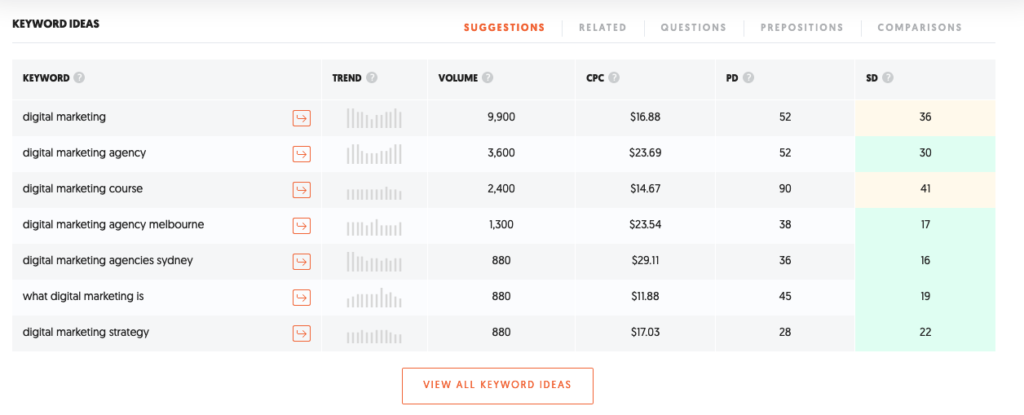
Keyword research helps you understand what your customers are searching for and their intent behind those searches. Use keyword research tools such as Google’s Keyword Planner, SEMrush or Ahrefs to:
- Discover popular search terms
- Evaluate search volume and competition
- Identify the intent (informational, transactional, navigational)
- Find related terms to include in your content
- Find and evaluate if KD (Keyword Difficulty) is appropriate
- Examine Competitors – Check their DR (Domain rating) and see if you can compete with them.
Here’s a screenshot from Neil Patel’s free keyword tool Ubersuggest. We’ll use this to illustrate the different keyword elements below, but you will see similar figures if you’re using a different tool.
RELATED: 9 basic SEO tips to help boost your Google rank.
Step 2: Determine keyword intent.
Understanding intent helps tailor your content to your audience’s needs:
- Informational intent: Searchers looking for answers or advice (e.g. ‘how to fix a leaky tap)
- Transactional intent: Users intending to purchase (e.g. ‘buy kitchen taps online’)
- Navigational intent: Visitors looking for a specific website or brand (e.g. ‘ABC Plumbing Sydney’).
Match your content style and information to meet this intent.
Step 3: Place keywords strategically.
Once you’ve chosen your keywords, placement matters:
- Meta titles: Clearly include your primary keyword at the start of the meta title. Keep it concise and appealing.
- Example: ‘Leaky tap repairs Sydney | ABC Plumbing’
- H1 headings: Use your main keyword naturally in your main heading (H1).
- Example: ‘Affordable leaky tap repairs in Sydney’.
Step 4: Integrate keywords naturally into your content.
Avoid keyword stuffing, as it makes your content hard to read and negatively impacts SEO. Instead:
- Sprinkle primary and secondary keywords throughout your paragraphs, subheadings (H2, H3) and bullet points
- Include related terms from your keyword research to enhance relevance
- Aim for readability and relevance.
RELATED: Your simple SEO checklist: Optimising your content.
Step 5: Optimise meta descriptions.
While meta descriptions don’t directly impact rankings, they encourage clicks. Include your primary keyword clearly to match user intent.
- Example: ‘Need leaky tap repairs in Sydney? ABC Plumbing offers fast, reliable plumbing services. Call now for a quote!’
Step 6: On-page keywords and local SEO.
On-page keyword optimisation is crucial for ensuring search engines understand the focus of your content. Pay special attention to:
- Title tags, headings, categories and URL mapping
- Image alt text
- Contextual keywords throughout your copy.
Local SEO is particularly important for businesses targeting specific geographic areas. Include location-specific keywords naturally in your content to improve local search visibility.
Takeaways.
Effective keyword integration is essential for improving your visibility online. Focus on keyword intent, strategic placement and natural integration for content that both readers and search engines love.
How digital marketing from Yellow Pages helps your business grow online.
The team at Yellow Pages provides expert digital marketing advice and products that boost your business’ online presence. From an online listing to digital display or social media ads, we’ll tailor a digital marketing strategy designed for your business. Find out more.
The post How to add keywords to your website and content – A beginner’s guide. appeared first on Yellow Pages.
]]>The post 7 ways to create a successful blog for your business. appeared first on Yellow Pages.
]]>1. Use a content calendar.

- Plan ahead: Set up a simple content calendar—ideally, plan at least one month in advance. This helps you avoid scrambling for ideas and ensures you’re always prepared.
- Seasonal relevance: Mark key dates (e.g. Mother’s Day, Christmas) to craft timely posts that resonate with your audience.
- Stay organised: Track blog titles, topics, target audiences and calls-to-action in one place to avoid repetition and cover diverse subjects.
RELATED: Your Australian calendar of events 2025.
2. Generate ideas with audience insights and SEO.

- Combine audience input and market research: While surveys and customer FAQs are valuable for inspiration, use keyword research tools (like Google Keyword Planner) to identify high-traffic topics. This ensures that even if your current audience is small, you’re creating content that attracts new readers via search engines.
- Address pain points: Base your topics on common questions and challenges your target users face—ensuring content that truly connects.
RELATED: Content ideas for every industry.
3. Prioritise consistency and quality over quantity.
- Stay one month ahead: Maintain a buffer of ready-to-publish content so you can consistently post without last-minute rushes.
- Focus on quality: Invest time in research and drafting. Well-researched, insightful posts that address real customer problems always outperform repetitive, low-value content.
- Value over volume: It’s better to produce fewer, high-quality posts than to publish mindless content just for frequency’s sake.
4. Deliver genuine value in every post.
- Offer actionable insights: Ensure every blog post provides clear, practical advice that solves problems or answers questions your readers have.
- Write with expertise: Demonstrate your authority by including data-backed insights, case studies or examples that highlight your industry knowledge.
- Keep it relevant: Stay focused on topics that matter to your target audience while avoiding unnecessary self-promotion.
RELATED: Your simple SEO checklist: Optimising your content.
5. Enhance readability and visual appeal.
- Flexible content length: While some topics require in-depth exploration, aim to keep posts engaging and digestible. Focus on what’s needed—sometimes shorter is better and sometimes longer content is warranted.
- Break up the text:
Use subheadings, bullet points and short paragraphs to improve readability. - Incorporate visuals:
Add images, infographics or videos to support your message. A visually pleasing layout encourages longer visits.
6. Optimise for SEO with intent and expertise.
- Beyond keywords: Effective SEO content writing means crafting posts that answer real user questions. Use your target keywords naturally in titles, subheadings and early in the content—but ensure they blend into a context of genuine expertise.
- Regular updates: Periodically refresh your posts to maintain relevance and boost search engine rankings. Update meta tags, links and any outdated data.
- Link strategically: Connect to related content (like our guide on content refresh) to enhance your site’s authority and provide extra value.
RELATED: The why, when & how of updating your website content.
7. Build and engage your audience.

- Promote your content: Actively share your blog posts on social media, in email newsletters and on relevant industry platforms. Use punchy posts with ‘read more’ links for social channels.
- Foster engagement: Respond to comments and ask for feedback to build a community around your blog.
- Grow your following: Leverage partnerships, guest posts or influencer collaborations to expand your reach and build a loyal audience over time.
RELATED: Mastering your online presence: How your website shapes your digital success.
Key takeaways.
- Content calendar: Plan one month ahead and include seasonal topics
- Idea generation: Use both audience insights and keyword research to choose relevant topics
- Quality and consistency: Focus on well-researched content and maintain a steady publishing schedule
- Deliver value: Offer actionable insights and demonstrate your expertise
- Readability: Use clear formatting and visuals for an engaging layout
- SEO optimisation: Write with intent, update regularly and integrate keywords naturally
- Audience building: Actively promote and engage with your readers to grow your following.
By implementing these 7 strategies, you’ll create a blog that not only attracts readers but also drives conversions and builds lasting trust.
RELATED: eBook: How to build an authoritative and trustworthy online presence.
How digital marketing from Yellow Pages helps your business grow online.
The team at Yellow Pages provides expert digital marketing advice and products that boost your business’ online presence. From an online listing to digital display or social media ads, we’ll tailor a digital marketing strategy designed for your business. Find out more.
The post 7 ways to create a successful blog for your business. appeared first on Yellow Pages.
]]>The post What is content marketing and why you need it for your business. appeared first on Yellow Pages.
]]>Although content marketing isn’t a new concept, it still proves to be one of the most widely used approaches to growing a business. In fact, content marketing continues to expand and adapt as different forms of content and new platforms emerge that become highly popular with consumers.
But what exactly is content marketing, and why do you need it for your business? Let’s take a closer look.

What is content marketing?
Content marketing involves creating, publishing and distributing a variety of content that is tailored to your target audience. Rather than trying to sell directly to potential customers, content marketing is about answering their questions, solving problems and providing meaningful value. This helps establish awareness, trust and credibility, which can ultimately lead to customers making a purchase.
Content can come in many forms, including:
- Blogs and articles
- Videos and gifs
- Infographics
- eBooks and whitepapers
- Landing pages
- Case studies
- Images and image galleries
- Webinars
- FAQ pages
- Social media posts
- Podcasts
Typically, content is created for and posted on your website, but it can also be distributed via email newsletters, social media and third-party websites or other platforms.
RELATED: Content marketing hacks – Tips from an SEO expert.

Why do you need content marketing for your business?
The benefits of content marketing are immense and far-reaching. The following are just some of the ways in which content marketing can help grow your business:
Lead generation.
The marketing sales funnel begins with brand awareness and lead generation, and content is vital at this stage of the customer journey. At this point, the customer is looking for information that is relevant to your business, which offers an opportunity to introduce your brand.
Here, content can be used to solve a problem or answer a potential customer’s questions. For example, let’s say you’re a Sydney-based florist and post a guide to Sydney flower seasons on your website. This content is useful for directing potential customers to your site when they search for related queries on Google, such as ‘What flowers are in season in Sydney?’.
Trust building.
For a customer to make a purchase, there must first be trust – trust that your products or services are worth investing in and trust that you will manage any issues if they arise.
According to Trusted Brands Australia, “[Trust] is that intangible quality that signals reliability and integrity. Whether it is a product or service, trust is what reassures us that we are making the right choice.”
When you create valuable content that solves a problem or addresses a need, your business becomes a trusted authority in your field. In turn, potential customers are more likely to seek your advice and recommendations in future, and consider your business first whenever they require your products or services.
RELATED: Content marketing ultimate guide for small businesses.
Improved organic search results.
The more high-quality, relevant content you produce, the greater your chances of appearing high up in search results any time a potential customer searches for something related to your business. This is incredibly important, because 75% of people never scroll past the first page of search results – so boosting your ranking is critical to driving traffic to your site.
Google also rewards fresh content, so making content marketing an ongoing priority is essential to getting noticed online.
To give you an example of what this might look like, an accountant could create content on what to do at tax time, including how to file your taxes, tax FAQs and what you can claim. This kind of content not only provides value, but also naturally includes keywords and phrases that their potential clients will be searching for.
RELATED: 5 simple tips for creating short-form video content.

Getting started with content marketing.
Building a content marketing strategy starts with defining your audience and goals and putting together a plan of attack. Consider the following questions:
- Who do you want to read your content? Tip: Consider your typical customer.
- What topics, questions and resources might your readers be searching for online?
- What content formats will you focus on? Tip: Stick to a few types for the first few months until you can gauge what works and what doesn’t.
- How many hours per week or days per month will you dedicate to creating content?
- Will you need external help with creating content or boosting your search engine rankings?
- How will you measure success? Tip: Consider traffic to your website, customer enquiries/leads and sales.
As a small business owner, you probably don’t have a lot of spare time for content creation. The good news is you can start small – maybe a blog every couple of weeks, a video each month and a social post every few days – to find out what resonates with your audience, then focus on the content types and channels that have the biggest impact for your business.
Download our free content marketing strategy template to get started.
RELATED: eBook: The ultimate guide to content marketing for small businesses.
The impact of AI on content creation.
You’ve probably heard of ChatGPT – nearly everyone has. Released in November 2022, the AI content-generating app attracted over 100 million users in just five days as it went viral on social media. Since then, ChatGPT has gone from strength to strength, with 180.5 million users worldwide and 100 million weekly visits to the website.
Whilst there’s a plethora of information around ChatGPT as well as the implications this can and has had on SEO, like any tool – knowing how to use it effectively is the key. That is why the team at Yellow Pages have put together a great guide on this very topic. Hiring a copywriter is still often the best option, but check out this guide to ChatGPT prompts and test it out for yourself to see how you can effectively implement AI into your overarching SEO and content strategy.
Be sure to check out our recently published 2024 guide to content marketing and take your SEO and content marketing efforts to the next level.
The post What is content marketing and why you need it for your business. appeared first on Yellow Pages.
]]>The post Content marketing strategy [TEMPLATE]. appeared first on Yellow Pages.
]]>There’s no doubt that, in a crowded – and often expensive – digital world, content marketing has become an essential for small businesses. The good news is, it’s one of the most economical forms of marketing available, as it capitalises on digital and other assets you most likely already have, such as your website, blog, social media and online business profiles, videos, FAQs, eBooks, photos, etc.
RELATED: What is content marketing and why you need it for your business.
Above all, content marketing has significant benefits in boosting your online presence and generating leads to your business, at a fraction of the cost of paid advertising.
In fact, recent studies show that:
- Businesses with a blog get 55% more visits to their website
- 70% of people would prefer finding out about a business through an article rather than an ad
- Per dollar spent, content marketing generates approximately three times as many leads as traditional marketing.
The key to a successful content marketing campaign is to utilise your content – blog articles, social posts, how-to videos, etc. – as effectively as possible, ensuring that it’s on the right platform, reaching the right audience and increasing engagement with your brand.
Related: Content marketing ultimate guide.
Not sure where to start? Read on.
Get started with content marketing using our free content strategy template.
To help you get started on your content marketing journey, we’ve created a handy template for you to use to outline your strategy – from setting up the team, identifying your main competitors and KPIs, to defining your audience, planning what content to develop and establishing where and when to post it. A content calendar is essential for planning and scheduling content effectively.
We’ve included guidance on evaluating existing content and establishing key performance indicators to measure the effectiveness of your strategy. It’s crucial for the marketing team to align their efforts and understand the target audience to create relevant and engaging content.
We’ve also provided a list of free or inexpensive tools to help you in the various stages of your strategy. Best of all, the template is in a PowerPoint format, so you can insert your own text and add or subtract pages to tailor your strategy to suit your business.
Get started with your content marketing strategy today.
Download FREE template.The post Content marketing strategy [TEMPLATE]. appeared first on Yellow Pages.
]]>The post eBook: The ultimate guide to content marketing for small businesses. appeared first on Yellow Pages.
]]>
Australians devote over half of their waking hours to interacting with digital media content. This makes content marketing an increasingly important way to promote your business, no matter how big or small.
Content marketing and an effective content strategy can yield results in growing your audience, boosting conversion and increasing engagement, Here’s some statistics that speak for themselves:
- 82% of marketers are actively investing in content marketing (Ahrefs)
- 45% of businesses plan to increase their content marketing budget in 2024 (Statista)
- Content marketing increases lead generation according to 74% of companies (Forbes)
- 73% of consumers prefer to learn about a product or service from a short video (Wyzowl).
So, what content formats make up content marketing?
The five main types of content marketing include social media, blog articles, podcasts, infographics and video. This means if you’re currently posting about your business on social media or you run a website for your services, you’re already engaged in content marketing.
To get you started, we’ve created an essential resource for any small business owner wanting to get results from content marketing, or anyone new to the world of digital content creation looking for some tips.
Whether you’re in search of innovative content ideas, new social media platforms, or ways to remain authentic to the objectives set out in your marketing plan, it’s time to explore new avenues of thinking to support the success of your campaigns.
In this eBook, we cover the fundamentals of successful content marketing:
- The current landscape at a glance
- What content marketing is
- The benefits content marketing can bring
- Steps to take before you begin
- Deep dive into the different content marketing formats – paired with good examples to inspire.
Click the download button below to get your FREE eBook and be sure to check our our recently published article on content marketing in 2024 and beyond.
Download eBook
The impact of AI on content creation and search.
Google’s Search Generative Experience (SGE), now known as AI Overviews, is transforming search with advanced AI. Although not yet available in Australia, businesses need to prepare for its impact and understand how it might shape changes in your overarching content strategy moving forward.
Read this article to learn more about how Google and AI is transforming search in Australia.
We’re sure you’ve heard of ChatGPT – nearly everyone has by now. What you may not know is whether it’s a good or bad thing when it comes to writing content and what its impact is on organic search.
Whilst there’s a plethora of information around ChatGPT, as well as the implications it can and has had on SEO, like any tool, knowing how to use it effectively is the key. That is why the team at Yellow Pages have put together a comprehensive guide to ChatGPT prompts and implementing AI as part of your overarching content strategy.
The post eBook: The ultimate guide to content marketing for small businesses. appeared first on Yellow Pages.
]]>The post What is user-generated content and how to use it to market your business. appeared first on Yellow Pages.
]]>Eighty-six percent of consumers believe that authenticity is important when deciding which brands they like and support and 60% of those people said that content is most authentic when created by consumers.
So if you’re not already creating content and utilising UGC within your marketing strategy, it’s time to get on board.
What is user-generated content?
As the name suggests, user-generated content is the content – such as images, videos, blogs, Tweets, testimonials or reviews – created by the users of your product or service. A UGC creator specialises in producing this type of content, often enhancing its authenticity and relatability.
User-generated content refers to things that can be used to help you market your business in some way. For example, it could be a photo with one of your products and a hashtag of your company name, a blog that mentions your services or a review left by a customer on your Google Business Profile.
RELATED: eBook: How to create standout online content for your business.
Benefits of UGC.
User-generated content is a popular tool to market a business or brand.. Here’s a few reasons why:
- Maintains brand authenticity: Consumers are more likely to view user-generated content as more authentic than brand-created content.
- Establishes trust: With the rise of influencer content saturating our social media feeds, sponsored posts and affiliate links have become overwhelming. As a result, nearly 90% of consumers have lost trust in influencers and are now seeking out user-generated content as a more authentic source of information.
- Brand Perception: More than 20% of consumers reported being influenced by well-written reviews when deciding on a purchase.
- Drives engagement: Social media campaigns that incorporate user-generated content get 50% more engagement.
- Cost-effective: Influencer marketing can be an expensive tool, while UGC allows you to generate personalised content without the cost.
- Increases conversions: UGC results in 29% higher conversion rates than campaigns that don’t use it.
- Showcase expertise: A compelling portfolio of UGC can attract potential clients and enhance credibility.
RELATED: Content marketing ultimate guide for small businesses.
How you should be using user-generated content.
1. Think of ways to encourage your customers to create content.
User-generated content (UGC) can be generated organically by your customer base, but it’s less common and can be time-consuming to find. A way to encourage its creation is to run social media campaigns with the intent of drumming up UGC. You might ask users to share an image and add a specific hashtag, or Tweet to your brand with a great idea, offering a reward or incentive.
2. Always request permission to post and credit the creator.
Before using a customer’s content, you must always get consent to repost what they have created. It will make them feel great to see you appreciate their content and will avoid any potential risk of issues regarding copyright.
Once you have the permission of the original creator, ensure you credit them within your post. This could be a tag in the post itself and reference to whether the image, video or text was created by them. Crediting the original creator not only shows appreciation but also helps in building their reputation as a successful UGC creator.
3. Put social listening practices in place.
Staying in the loop with what your customers are saying about you is key to leveraging UGC for your business’ social media strategy. Scanning social media, however, for customer-created content can be time consuming, particularly if you’re operating across multiple platforms, such as Instagram, Facebook, Twitter, TikTok, Pinterest and YouTube. Engaging with the UGC creator community can also provide valuable insights and opportunities for collaboration.
Here’s some time-savvy ways to efficiently collect UGC:
- Set up Google Alerts: Google Alerts is a free tool that monitors the web for phrases you choose, such as your business name, industry, or location. Whenever your chosen phrase is mentioned online, you’ll receive an email notification. This helps you stay informed about online conversations related to your business, like blog mentions or positive reviews, which you can repurpose as your own content.
- Turn on tagged notifications: Ensure your notifications are enabled for tagged content from users you don’t follow on platforms like Instagram, Facebook and Twitter. This ensures you won’t miss any posts, comments, or stories where your business is mentioned.
- Use TweetDeck: TweetDeck is a free tool that lets you monitor what people are saying about your brand on Twitter, even if they don’t tag your handle. By setting up a custom stream with specific phrases, you can keep track of relevant mentions.
- Try social listening tools: Consider testing tools like HootSuite or Buzzsumo, which offer free 30-day trials. These paid tools provide similar functionality to TweetDeck but across all social media platforms, making it easy to find and leverage UGC for your social media strategy.
RELATED: Content ideas for every industry.
Examples of successful user-generated content.
No matter what size of business, brands utilise user-generated content to increase brand awareness, drive conversions and boost engagement in a cost-effective way.
Successful UGC creators often leverage these strategies to enhance their social media presence and drive engagement. Get inspired with these examples.
1. Images.
UGC content creators often excel in producing visually appealing images that resonate with audiences. Minbie, an Australian baby product brand, repackages pictures that mums share of their babies enjoying Minbie products online and reposts them to their social feed. What’s great about Minbie’s posts is that they create excitement around receiving customer images, encouraging users to take content and share it with the chance to ‘get featured’ on their Instagram profile.

2. Videos.
The authentic nature of a UGC video can significantly enhance viewer engagement and trust. Everyday Salon is a Melbourne-based hairdresser that reposts videos created by their customers to their Instagram feed. The video shared by one customer gives an insight into the best bits of going to visit this particular salon, selling the overall experience as a ‘pick me up’. This content works as a ‘free’ form of advertising, encouraging other followers to get their hair done too.

3. Reviews.
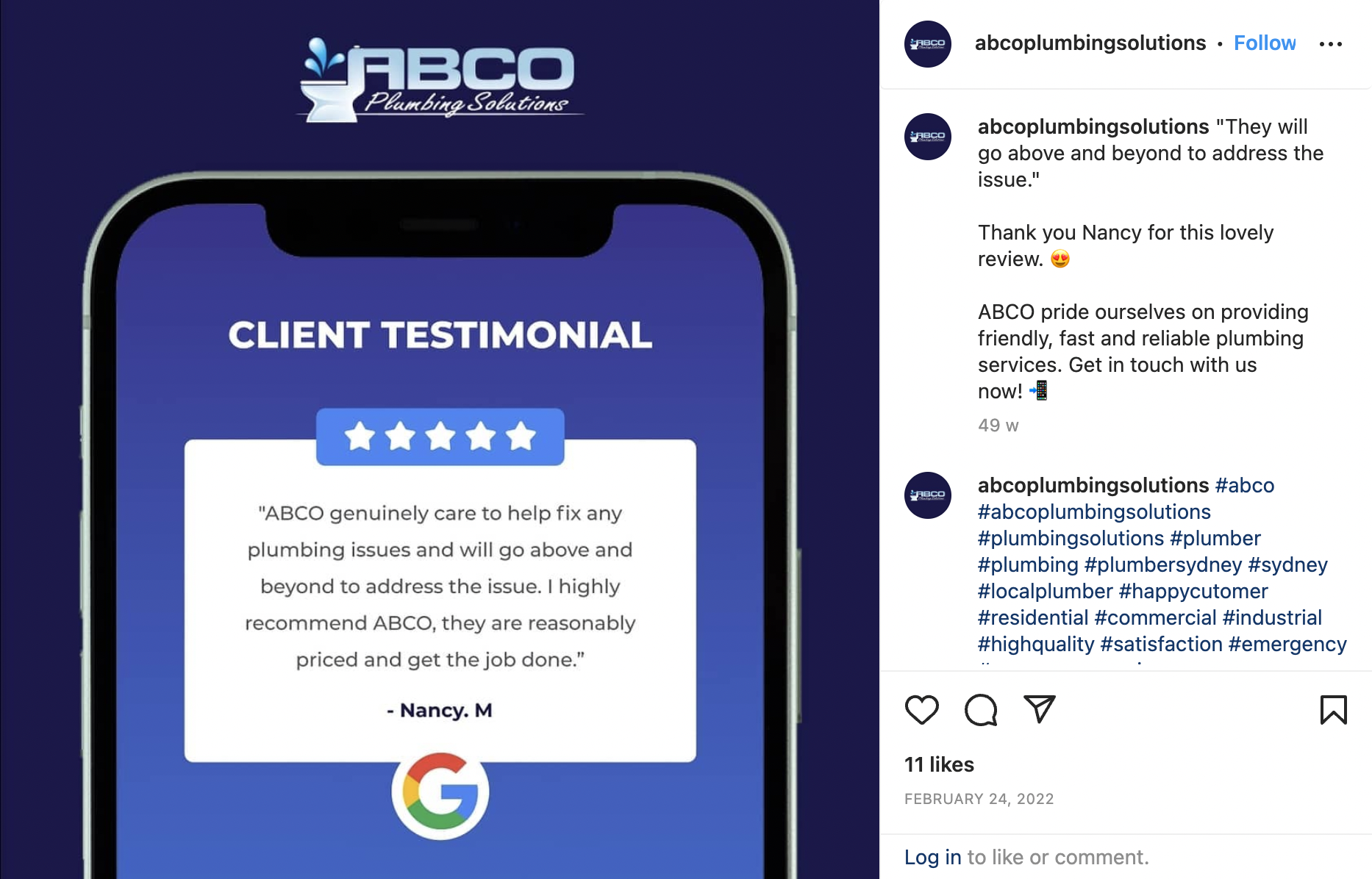
Reviews are a crucial aspect of UGC creation, providing authentic feedback that can influence potential customers. ABCO Plumbing is a plumbing service in New South Wales that shares top reviews written by customers in the form of a social media post. Reviews work to build trust with your following due to the expectation that if another customer was happy with the results, you will likely be happy too. Reviews are also a great opportunity to shout about the work you are doing and how well it is being received – straight from the customer’s mouth.
Time to get started?
User-generated content can demonstrate the capability of your product or service to potential customers, boost awareness, and increase social proof during the purchase journey. By leveraging UGC across various social media platforms, you can maximise your reach and customer engagement.
Get in touch with Yellow Pages’ team of experts to set up strategic Social Ads campaigns to reach new audiences and drive growth for your business.
The post What is user-generated content and how to use it to market your business. appeared first on Yellow Pages.
]]>The post 5 simple tips for creating short-form video content. appeared first on Yellow Pages.
]]>Platforms like TikTok, Instagram Reels and YouTube Shorts have significantly contributed to the popularity of short-form videos by delivering concise messaging that captures viewer attention quickly.
Notably, consumers are more likely to watch short-form video until the end, which is part of what makes them such a powerful marketing format for businesses.
Are you looking to improve your current video strategy? Or simply wanting to try out short-form video for the first time? Whatever your goals are, this guide will give you all the information you need to produce high-quality short-form videos that drive reach, engagement and leads for your business. Incorporating a short form video strategy is crucial to maximising engagement and staying ahead of video trends.
RELATED: The video marketing age: a guide for small businesses
What is a short-form video?
Short-form videos are defined as video content lasting between 5 to 90 seconds, In general, anything longer than this is considered to be long-form video.
The content itself can include anything from GIFs or simple animation to a full production video cut back into shorter snippets.
Video distribution platforms that support short-form content have grown over the years. The original leaders in this format were Vine in 2013, with the trend later picked up by TikTok in 2017 and, more recently, by Instagram as Reels, YouTube as Shorts and Snapchat as Spotlight.
These platforms offer various short-form video features, such as TikTok’s easy-to-use editing tools, Instagram Reels’ integration with Stories, and YouTube Shorts’ accessibility from the main YouTube app, making it easier for users to create and engage with short videos.
Each platform has its own definition of ‘short-form’ video. These include:
- TikTok: 3 seconds – 3 minutes (with the ability to extend to long-form at 10 minutes)
- Instagram Reel: 15 seconds – 1.5 minutes
- Instagram Video posts: 3 seconds – 10 minutes
- Instagram Stories: 1 second – 1 minute
- Facebook Reel: 15 seconds – 1.5 minutes
- Facebook Video posts: 1 second – 241 minutes
- Facebook Stories: 1 second – 2 minutes
- YouTube Short: 15 seconds – 1 minute
- Snapchat Spotlight: 5 seconds – 1 minute
- LinkedIn Stories: 1 – 20 seconds
- Pinterest Idea Pins: 4 seconds – 15 minutes
So, why are marketers going crazy for short-form video? The answer is, it produces higher engagement and increased leads.
- 44% of consumers prefer to watch short-form video to learn about a product or service
- Of all types of video, short-form has the highest ROI and drives the most lead generation and engagement
- TikTok’’s monthly usage has surged, with users now spending an average of 34 hours per month on the platform which is equivalent to 1360, 90 second videos.
RELATED: Content ideas for every industry.
How to create a successful short-form video.
Getting started can be the hardest part of content creation. Brands can create videos to engage audiences through short-form content, making the process more effective. Follow these five top steps to streamline the process and achieve better results.
Incorporating video marketing strategies is crucial to enhance the effectiveness of your video content.
1. Stay up to date with short-form trends.
Keep an eye on the types of videos that perform well on social media to leverage short form video trends and maximise engagement. Staying updated with the latest trends is crucial for marketers to incorporate trending elements into their content.
Understanding the top video marketing trends for 2024 is essential for adapting your strategy to meet expert expectations and achieve greater reach and success.
Here are the best ways to identify trends for your video content strategy:
- Instagram Story Music: Instagram’s Story section suggests popular songs. Use this feature to select trending music for your videos.
- Explore and discover Pages: Both Instagram and TikTok have pages curated based on your past interactions. Check these pages regularly to see what’s trending.
- TikTok’s Creative Center: This tool lets you find trending hashtags, songs, creators, and videos on TikTok. You can filter by engagement metrics like likes or comments and view trends from the past 7, 30, or 120 days.
- Reels Hashtag Search: Use the Explore page on Instagram and enter relevant hashtags. This will show you what your industry competitors are creating and provide inspiration for your strategy.
2. Cater to sound-off users.
With many users now preferring to watch videos without sound, it’s crucial to create content that caters to this preference.
Here are a few ways to do this:
- Written Subtitles: Always add captions to ensure your message is accessible
- Animations and Gestures: Use visual cues to convey your message, like in silent movies
- Demonstrative Content: For example, a how-to video on decorating a cake.
Most social media platforms offer built-in tools to add closed captions. Here’s how to do it:
- Instagram: Upload your video, select the ‘stickers’ icon, tap the ‘captions’ sticker and edit the auto-generated captions before posting
- TikTok: Upload your video, tap the ‘captions’ icon, edit any incorrect words and save your video
- Facebook: Upload your video, select the ‘captions’ icon from the menu,and edit the auto-generated captions before posting.
3. Focus on audience versus product.
If you receive frequent questions on a specific product or service, use this to inform your script or video concept. For instance:
- If you often get queries about getting a quote for your home painting business, create a video explaining the quote process
- If you sell baby products and receive questions about using a bottle steriliser, produce a how-to video on the steriliser’s use.
Businesses are increasingly turning to FAQ-driven content in their short-form videos to directly address customer inquiries and enhance engagement
Need some more inspiration on how to create audience focused short-form video content? Read our guide on content ideas for every industry.
4. Ensure high quality.
High-quality video is more enjoyable and engaging than wobbly, pixelated content. Here’s what to consider during production:
- Lighting: Use good lighting to enhance video clarity
- Clean Background: Ensure a clean, distraction-free background
- Stability: Use a tripod to avoid shaky footage
- Camera: Shoot with your phone’s back camera for better quality
- Variety: Film from multiple angles
- Clear Audio: Ensure crisp sound if using the original audio.
5. Edit content well.
Social media apps offer free in-app editing capabilities, which can help to make video content marketing accessible to everyone. In-app editing offers the use of app-specific fonts, as well as a first-hand view of what the finished product will look like (this can sometimes change when uploaded from a third-party app).
If you prefer to edit on your computer, Mac users can use iMovie and PC users can use Windows Movie Maker. Alternatively, if you would like to edit on your phone but would like an editing tool that is not operating system-specific, you may like to try InShot.
Here are some key editing tips:
- Adjust Lighting: Enhance the video’s brightness and contrast
- Crop Pauses: Remove any unnecessary pauses or silences
- Add Music: Incorporate background music that complements the content
- Transitions: Use transitions to make your video flow smoothly
- Noise Cancellation: Remove any background noise if using original audio.
Wrapping up.
Now you’ve got everything you need to create a short-form video for your business’ social media platform, it’s time to think about the ways in which you will promote your content.
Need help getting started? Yellow Pages’ team of experts can help drive your social media marketing to new heights through targeting customers based on details like location, interests and behaviours. Get in touch today.
The post 5 simple tips for creating short-form video content. appeared first on Yellow Pages.
]]>The post Marketing Jargon Buster: Content Hygiene. appeared first on Yellow Pages.
]]>It is the process of regularly checking your online content to ensure that all the information is up-to-date, correct and consistent across your brand.
This includes:
- Contact details on your website, online listings and social media
- Products and/or services offered
- Links on your website and online listings
- Blogs and social media posts.
RELATED: Content marketing in 2024: Ultimate guide for small business.
Why is content hygiene important?
- Keeping your details up-to-date ensures your customers can find you online
- And, once they’ve found you, it ensures they can easily get in touch with you
- Lets your customers know that you can provide the goods and services they need
- Keeps you top of mind with updated blogs and social posts.
RELATED: How to identify and refresh under-performing content.
RELATED: Evergreen content and how it can help your brand.
The post Marketing Jargon Buster: Content Hygiene. appeared first on Yellow Pages.
]]>The post Marketing Jargon Buster: Content Marketing appeared first on Yellow Pages.
]]>The process of creating online content, such as:
- Blog articles
- eBooks
- Online videos
- Social media posts
The intention of content marketing is to drive engagement with your business by providing interesting, entertaining and useful content to your audience.
Why content marketing?
- Good content is what makes your business stand out from the crowd
- It is one of the most cost-effective forms of marketing, as one piece of content can generate multiple engagements over time
- It grows your brand awareness and nurtures your current customers at the same time.
RELATED: 5 simple tips for creating short-form video content.
The post Marketing Jargon Buster: Content Marketing appeared first on Yellow Pages.
]]>